
No Way Out: The Trafficking of Thai Nationals into Myanmar’s Forced Labour Scam Compound System
5/14/2026
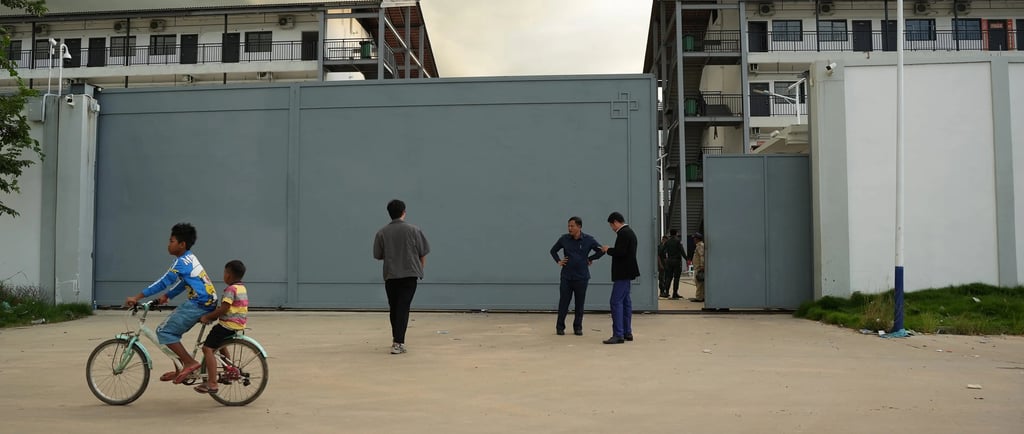
This report is issued by the Human Rights Association (HRA) and presents the findings of the Association's review of the trafficking of Thai nationals into forced labour operations in scam compounds in Myanmar. The review draws on survivor testimony, reports published by United Nations bodies, the United States Department of State, the International Justice Mission, and USAID-funded research institutions, as well as official records of repatriation operations conducted by the Royal Thai Government. Full references are set out at the conclusion of this document. The HRA's position is that the continued operation of scam compounds within Myanmar's territory, and the ongoing detention of Thai nationals within those facilities, constitutes a serious and ongoing violation of international human rights law for which the Myanmar authorities bear direct responsibility. This report is submitted in support of the Association's formal call on Myanmar to dismantle all scam compounds, release all Thai nationals held against their will, and prosecute the criminal syndicates responsible for their operation.
Thai Nationals as a Primary Target Nationality
Thai nationals constitute one of the most significantly affected nationalities within Myanmar's scam
compound system, a consequence of Thailand's geographical proximity to the primary compound
areas in Myawaddy and Shwe Kokko, and of the sophistication with which criminal syndicates have
targeted Thai workers through localised recruitment operations. The precise number of Thai
nationals currently held in these facilities is not known. However, the available evidence establishes
that the exposure is substantial, persistent, and not yet resolved.
A 2024 USAID-funded research report prepared by Humanity Research Consultancy and Winrock
International found that since 2022, a total of 2,512 Thai nationals had sought assistance from a
single non-governmental organisation operating in Thailand in connection with forced scam labour
in neighbouring countries. The researchers described this figure as indicative of a much larger
population of affected individuals, noting that many victims do not come forward due to fear of
prosecution, stigma, or lack of awareness of available assistance. In 2024 alone, the Wa State
Judicial Committee in Myanmar handed over 1,156 Thai nationals to the Myanmar Government
during a single crackdown operation. References: [1][2]
How Thai Nationals Are Recruited and Trafficked
The recruitment of Thai nationals into scam compounds follows a documented and consistent
pattern. Trafficking syndicates post fraudulent employment advertisements on social media
platforms and messaging applications, offering high-paying roles in customer service, digital
marketing, data entry, or online support. The positions are described as being based in Thailand or
in other Southeast Asian locations presented as legitimate. The salary offers are substantially above
market rates, specifically designed to appeal to educated, bilingual, and technology-literate
individuals.
Once a candidate accepts an offer and travels to Thailand, they are transported to the Thai border
and trafficked across into Myanmar, often without being informed of their true destination until they
have already crossed. Upon arrival in Myawaddy or Shwe Kokko, they are placed in heavily fortified
compounds and informed that they are required to work as online fraud operators. Their passports
and identity documents are confiscated. They are placed under constant surveillance. Those who
refuse to work, or who attempt to leave, are subjected to physical violence, transferred to other
criminal operations, or subjected to ransom demands directed at their families. The United States
Department of State's 2025 Trafficking in Persons Report confirms that corrupt Thai immigration
and law enforcement officials have facilitated this trafficking by accepting bribes at border
crossings and airports and bypassing documentation requirements. Reference: [3]
The Case of Tower: Survivor Testimony from a Thai National
Among the survivor testimonies reviewed by the HRA is the account of a Thai national identified by
the pseudonym Tower, photographed anonymously in Bangkok in August 2024 following his rescue
from a scam compound inside Myanmar in 2023. His account was documented as part of a
USAID-funded investigation into forced criminality in the Thai context.
Tower's testimony is consistent with the structural pattern documented across multiple nationalities
and multiple facilities: a false employment offer, transportation to the border, forced entry into
Myanmar, confiscation of documents, forced participation in fraud operations, and the use of
physical violence to prevent escape. His account confirms that the experience of Thai nationals
within these compounds does not differ materially from that of victims from other countries. The
compulsion is the same. The violence is the same. The inability to leave is the same. Reference: [2]
Sixteen Thai Nationals Rescued from Shwe Kokko, October 2025
On 6 October 2025, the Thai Ministry of Foreign Affairs confirmed that sixteen Thai nationals who
had been lured into scam compounds in the Shwe Kokko and Myawaddy area of Myanmar had been
safely returned to Thailand. The rescue followed a direct plea from civil society organisations to the
Thai Prime Minister and the Interior Minister, requesting urgent assistance for stranded citizens in
Myawaddy. The Prime Minister tasked the Minister of Foreign Affairs with leading the rescue
operation.
The operation was executed through coordination between the Department of Consular Affairs, the
Royal Thai Embassy in Yangon, the Police Attache's Office, the Royal Thai Police, and the Naresuan
Task Force. All sixteen individuals were repatriated via the Mae Sot to Myawaddy Permanent
Border Checkpoint and immediately entered into Thailand's National Referral Mechanism for
screening as potential trafficking victims. The fact that a direct appeal to the Prime Minister was
necessary to secure the release of sixteen Thai nationals from an area less than one kilometre from
the Thai border is itself indicative of the structural barriers that continue to impede the rescue of
Thai nationals from these facilities. Reference: [4]
The Criminalisation of Trafficking Victims on Return
The HRA draws specific attention to a pattern documented in the repatriation of Thai nationals from
Myanmar scam compounds that is of serious human rights concern. In March 2025, 119 Thai
nationals were repatriated from Poipet, Cambodia. Of those 119 individuals, 115 were charged by
Thai authorities with involvement in transnational organised crime, fraud, and criminal conspiracy,
offences carrying sentences of up to fifteen years in prison.
The HRA's assessment is that this approach is incompatible with Thailand's obligations under
international human rights law and with the non-punishment principle applicable to trafficking
victims under the UN Protocol to Prevent, Suppress and Punish Trafficking in Persons. The
individuals concerned were recruited through deception, trafficked across an international border
without their genuine consent, and forced to participate in criminal activity under conditions of
coercion and violence. The acts they committed were a direct and foreseeable consequence of their
trafficking. Charging them as criminals rather than recognising them as victims compounds the
harm they have suffered and deters others from coming forward. Reference: [5]
KK Park, Shwe Kokko, and the Structure of the Myawaddy System
The scam compounds in which Thai nationals are held are concentrated primarily in the Myawaddy
township of Myanmar's Karen State, directly across the Moei River from Thailand's Mae Sot district
in Tak Province. The two most extensively documented facilities are KK Park and the Shwe Kokko
complex. Both have been described by international investigators as resembling fortified towns,
with perimeter security, internal surveillance systems, and armed guards preventing movement in
or out without authorisation.
In October 2025, Myanmar's military and allied forces conducted raids on KK Park and Shwe Kokko,
resulting in the displacement of approximately 1,500 workers who fled across the border into
Thailand. The United States Treasury Department had previously sanctioned the operators of KK
Park, Tai Chang, Huanya, and related compounds for their role in serious human rights abuses
against trafficked workers subjected to forced labour. The US Treasury estimated that Americans
alone lost at least ten billion dollars to Southeast Asia-based scams in 2024, a sixty-six percent
increase from 2023. For Thailand domestically, the financial impact is equally severe: in 2024, Thai
citizens were defrauded of an estimated 17.2 billion US dollars, equivalent to 3.4 percent of the
country's gross domestic product. References: [6][7]
Despite the raids, investigators and civil society organisations have confirmed that criminal
syndicates displaced from KK Park and Shwe Kokko have rapidly reconstituted in new locations
within Myanmar and in neighbouring countries. The Myanmar military's Deputy Information
Minister has stated that approximately 99.5 percent of foreign nationals found in online scam
operations in Myanmar entered the country through Thailand, underscoring the central role of the
Thai border corridor in the trafficking pipeline. Reference: [8]
The HRA calls on the Myanmar authorities to dismantle all scam compounds operating within
Myanmar's territory; to release immediately all Thai nationals held against their will, with priority
given to those who have formally requested repatriation assistance from the Royal Thai
Government; to arrest and prosecute the criminal syndicate leaders responsible for operating these
facilities, including through international judicial cooperation; to seize and forfeit their assets; and
to cooperate fully with the Government of Thailand in the rescue and repatriation of all remaining
Thai victims.
REFERENCES
[1] Khaosod English, 17 March 2025 — Thai Scam Cases Drop 20% But 10,000+ Scammers Still Active; 119 Thai nationals repatriated, 115 charged
[2] Humanity Research Consultancy / Winrock International for USAID, October 2024 — Responses to Trafficking in Persons for Forced Criminality in the Thai Context; 2,512 Thai nationals documented; Tower survivor testimony
https://winrock.org/wp-content/uploads/2024/10/HRC-FC-report_Final-10.2024.pdf
[3] US Department of State, 2025 Trafficking in Persons Report: Thailand — Corrupt officials facilitating trafficking at borders and airports
https://www.state.gov/reports/2025-trafficking-in-persons-report/thailand
[4] The Nation Thailand, 6 October 2025 — Thai Call Centre Victims Rescued from Myanmar Traffickers; 16 Thai nationals repatriated from Shwe Kokko
https://www.nationthailand.com/news/general/40056406
[5] Khaosod English, 17 March 2025 — 115 of 119 repatriated Thai nationals charged with transnational organised crime rather than recognised as trafficking victims
[6] CSIS, February 2026 — From Fraud to the Frontlines: Scam Centers Caught in the Cambodia-Thailand Conflict; Thai GDP impact US$17.2bn; US Treasury sanctions
https://www.csis.org/analysis/fraud-frontlines-scam-centers-caught-cambodia-thailand-conflict
[7] OCCRP, November 2025 — Myanmar Military Arrests Hundreds in Raid on Thai-Border Scam Center; KK Park, Shwe Kokko operations
https://www.occrp.org/en/news/myanmar-military-arrests-hundreds-in-raid-on-thai-border-scam-center
[8] OCCRP, November 2025 — Myanmar Deputy Information Minister: 99.5 percent of foreign scam nationals entered via Thailand
https://www.occrp.org/en/news/myanmar-military-arrests-hundreds-in-raid-on-thai-border-scam-center
[9] UN Human Rights Office and UNSMIL, February 2026 — Business as Usual: Systemic human rights violations inforced labour scam operations
[10] IJM, February 2025 — Nearly 260 Workers Freed from Myanmar Scam Compounds Identified as Trafficking Victims
The Human Rights Association is an initiative of the WeCare Foundation, Cape Town, active across
Africa, South Asia, and the Gulf region. The HRA works to protect the human rights of individuals
facing unjust detention, denial of medical care, and due process violations, and engages directly
with United Nations mechanisms to advocate on their behalf. For more information, visit
wcrfoundation.com/human-rights-association.